
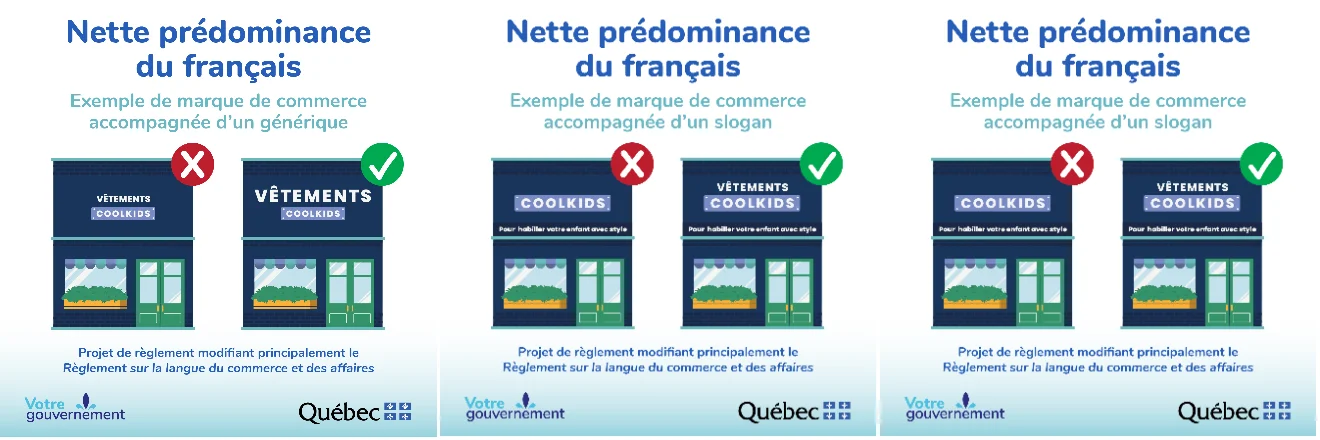
Source: Quebec Office of the French Language (OQLF)
Starting June 1, 2025, significant changes will take effect in Quebec regarding the use of trademarks in languages other than French, under Bill 96, which amends the Charter of the French Language. These changes aim to strengthen the presence of French in businesses and ensure that French is clearly predominant in commercial activities. Below is a comprehensive guide to understanding these new rules and avoiding costly penalties.
1.Mandatory Registration of Foreign-Language Trademarks
One of the most significant changes concerns the use of trademarks in a language other than French. As of June 1, 2025, a trademark written solely in a foreign language can only be used in Quebec if:
- It is registered with the Canadian Intellectual Property Office (CIPO).
- No corresponding French version is registered in the trademark registry.
This means that unregistered trademarks or those in the process of registration will no longer benefit from the exemption allowing their exclusive use in a foreign language. For example, a trademark like “Tech Solutions” must be registered to be used solely in English, unless an equivalent French version, such as “Solutions Technologies,” is also registered.
2.Mandatory Translation of Descriptive and Generic Terms
Even if a trademark is duly registered in a foreign language, any generic or descriptive terms it contains must be translated into French on the product or on a permanent medium.
- Common examples :
- “Toothpaste” must be accompanied by “Dentifrice.”
- “Mint Flavor” must be translated as “Saveur de minthe.”
- “Whitening” must be accompanied by “Blanchissant.”
This rule applies not only to packaging but also to labels, user manuals, and any other permanent medium associated with the product.
3.Public Signage and Commercial Advertising: Clear Predominance of French
The new rules also impose strict requirements for public signage and commercial advertising:
- French must be markedly predominant over other languages.
- French text must have a significantly greater visual impact than text in a foreign language, occupying at least twice as much space and being at least as legible and visible.
- This rule applies to websites, commercial signs, billboards, and any other promotional material visible to the public.
4.Transition Period for Non-Compliant Products
Businesses will benefit from a transition period to comply with these new rules:
- Non-compliant products manufactured before June 1, 2025, may be sold until June 1, 2027, provided they are not modified after that date.
- However, this exemption does not apply if a French version of the trademark was filed in the trademark registry by June 26, 2024.
5.Penalties for Non-Compliance
Businesses that fail to comply with these new requirements face administrative and penal sanctions, including:
- Fines :
- $700 to $7,000 for a first offense.
- $1,400 to $14,000 for a repeat offense.
- For corporations, fines may be doubled if the offense is committed by a legal entity.
- Permit Suspension :
- The OQLF may recommend the suspension or revocation of commercial permits for repeated non-compliance.
- Court Orders :
- In cases of serious or repeated violations, the OQLF may seek a court order to compel compliance.
6.Recommendations for Businesses
To avoid these penalties, businesses should:
- Verify that their foreign-language trademarks are duly registered with CIPO.
- Translate descriptive and generic terms on products and packaging.
- Adapt public signage and commercial advertising to comply with the new French predominance rules.
- Review their branding strategy to ensure long-term compliance.
- Plan now to avoid high compliance costs at the last minute.
Conclusion
These new rules represent a major shift for businesses operating in Quebec. To avoid costly penalties and maintain a strong market reputation, it is essential to prepare now and implement strategies to comply with these new requirements.